
Independent fan guide. All facts current as of June 28, 2026.
A Final-Day Cliffhanger
On the pitch at Lord’s, the last pieces of a month-long puzzle are falling into place.
For sixteen days, twelve teams have fought across England. Today, the group stage ends. And it ends with real drama, not the made-up kind.
Two semi-final spots are already locked. Hosts England go in unbeaten. The West Indies survived a wobble to join them. But the other two spots? Still up for grabs, with Australia, India, South Africa and Bangladesh all chasing them on the same afternoon at the same ground.
This is why the Women’s T20 World Cup matters. It is fast. It is loud. It never lets you look away.
Here is everything you need to know about the 2026 tournament — who has qualified, who is still fighting, who are the star players and where this thing is headed.
Tournament Overview: The Basics
The 2026 ICC Women’s T20 World Cup is the tenth edition of the tournament. England and Wales are hosting it, from June 12 to July 5. England also hosted the very first edition back in 2009.
This is the biggest Women’s T20 World Cup ever held. Twelve teams are playing, up from ten in 2024. That is the largest field in the event’s history.
How teams qualified: Host nation England qualified automatically. So did the top five teams from the 2024 tournament — Australia, India, New Zealand, South Africa and the West Indies. Pakistan and Sri Lanka took the next two spots based on ICC rankings. The final four places went to Bangladesh, Ireland, Scotland and the Netherlands, who all came through a global qualifying event. The Netherlands are playing in their first-ever Women’s T20 World Cup.
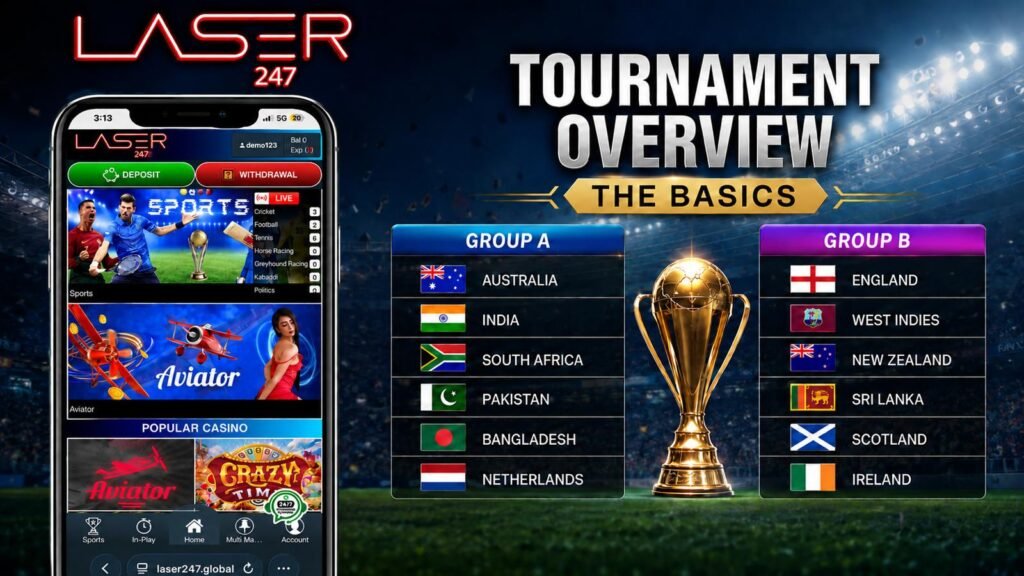
The format: Twelve teams split into two groups of six, Group A and Group B. Every team plays the other five teams in its group once. The top two from each group reach the semi-finals.
Group A: Australia, India, South Africa, Pakistan, Bangladesh, Netherlands Group B: England, West Indies, New Zealand, Sri Lanka, Scotland, Ireland
Venues: Seven grounds are hosting matches: Edgbaston (Birmingham), Old Trafford (Manchester), Headingley (Leeds), the Bristol County Ground, the Rose Bowl (Southampton), Lord’s and The Oval (both in London). Both semi-finals are at The Oval, on June 30 and July 2. The final is at Lord’s on July 5.
Conditions: English wickets in June tend to offer something for the seamers early in the day, especially under cloud at grounds like Old Trafford and Headingley. As the tournament moves into July, pitches generally flatten out, and grounds like Edgbaston and The Oval have already produced big scores. England’s 219 for 1 in the opening match at Edgbaston was the highest total of the group stage.
Prize money: The ICC has put up a total prize pool of $8.76 million. The champions take home $2.34 million. The runners-up get $1.17 million. Even losing semi-finalists earn $675,000 each.
Where Things Stand Right Now
Group B is finished:
England went through the entire group stage unbeaten, finishing 5 wins from 5 and topped the table. The West Indies finished second despite losing their last group game to Ireland — their net run rate was just enough to hold off Sri Lanka, who also finished on six points. New Zealand, the defending champions, lost their final group match to England and were eliminated. Scotland and Ireland both finished with two points, but Ireland’s win over the West Indies in the last round was their first-ever Women’s T20 World Cup victory. Scotland’s win over Ireland earlier in the tournament was also a historic first.
Group A is still being decided as this is written:
Australia have been the best side in the group, winning all four of their matches so far with a massive net run rate. India sit second on six points, their only defeat coming against South Africa. South Africa are also on six points after beating Australia’s nearest challengers in style. Bangladesh, on four points, still have a mathematical shot. Pakistan and the Netherlands have already been eliminated.
Today, South Africa play Bangladesh and Australia play India, both at Lord’s. India carry a healthy net-run-rate cushion over South Africa, an even bigger one over Bangladesh, which makes them the favourites to join Australia in the semi-finals. But nothing is confirmed until the last ball is bowled.
One more wrinkle: tournament rules state that if India qualify, they are guaranteed a place in Semi-Final 1 on June 30, regardless of where they finish in Group A — a scheduling call almost certainly shaped by India’s enormous broadcast audience.
Team-by-Team Breakdown
England (Group B) — Qualified, unbeaten. Captain Nat Sciver-Brunt leads a host nation that has not lost a match all tournament. Danni Wyatt-Hodge has been among the tournament’s top run-scorers, while Lauren Bell, Charlie Dean and Sophie Ecclestone give England a varied, dangerous bowling attack. Their strength is balance — there is no obvious weak link. Their challenge is purely mental: carrying an unbeaten run into knockout cricket, where one bad day ends everything.
Australia (Group A) — Virtually qualified. Six-time champions and the most successful side in the tournament’s history, Australia have reached seven finals in nine editions. New captain Sophie Molineux, leading her first major tournament, has guided an undefeated group-stage campaign built on Ellyse Perry’s all-round excellence and one of the deepest bowling units in the competition. The challenge: a first-time captain has to prove she can handle a knockout final the way Meg Lanning once did.
India (Group A) — In contention. Harmanpreet Kaur captains a side that has never won this trophy, despite reaching the final once, in 2020. Shree Charani has been the standout bowler of the entire tournament, while Shafali Verma and Jemimah Rodrigues give India explosive top-order firepower. Their one defeat came against South Africa. Their challenge is simple: beat Australia today or lean on their net-run-rate cushion to survive.
South Africa (Group A) — In contention. Captain Laura Wolvaardt leads a team that has reached the last two finals (2023 and 2024) without winning either. Marizanne Kapp’s unbeaten 81 turned their match against India, and Tazmin Brits scored her maiden T20I century against the Netherlands. Their challenge is the one that has followed them for years: getting over the final hurdle.
Bangladesh (Group A) — Long shot. Captain Nigar Sultana Joty’s side need a big win over South Africa today, plus help from elsewhere, to sneak through. Spin has been their strength all tournament. Their net-run-rate deficit is the steepest of the four teams still chasing a semi-final spot.
Pakistan (Group A) — Eliminated. Captain Fatima Sana was outstanding individually, finishing among the tournament’s leading wicket-takers. But a fragile batting order meant Pakistan’s bowling-heavy squad could not turn performances into wins, finishing with just one victory.
Netherlands (Group A) — Eliminated, but memorable. Debutants at this World Cup, the Dutch finished without a win. But captain Babette de Leede was a genuine bright spot, finishing among the tournament’s top run-scorers despite her side’s results — a valuable, confidence-building first appearance on the biggest stage.
New Zealand (Group B) — Eliminated. The defending champions are out, and that is the single biggest shock of this tournament so far. New captain Amelia Kerr, who was Player of the Tournament when New Zealand won the title in 2024, came in with strong individual form, but the team lost too many close group games. Veterans Suzie Bates and Sophie Devine are playing their farewell tournament before retiring.
West Indies (Group B) — Qualified. Captain Hayley Matthews, the 2016 champions’ all-round leader, got her side through despite a late wobble — a surprise loss to Ireland in the final group match. Deandra Dottin and Stafanie Taylor add experience and power. Their challenge: shaking off that late stumble before the semi-final.
Sri Lanka (Group B) — Eliminated on net run rate. Captain Chamari Athapaththu’s side won three of five matches, the same points total as the West Indies, but their net run rate fell just short. A dramatic three-run win over Scotland was a tournament highlight.
Scotland (Group B) — Eliminated but a breakout campaign. Captain Kathryn Bryce’s side, playing as an Associate nation, recorded their first-ever Women’s T20 World Cup win and were genuinely competitive throughout. Darcey Carter finished as the tournament’s leading run-scorer at the time the group stage ended.
Ireland (Group B) — Eliminated, but historic. Captain Gaby Lewis’s side ended their campaign with their first-ever Women’s T20 World Cup victory, beating the West Indies in the final group match. All-rounder Orla Prendergast was excellent with bat and ball throughout.
Star Players to Watch

Amelia Kerr (New Zealand) was Player of the Tournament in 2024 and remains one of the most complete all-rounders in the women’s game, even with New Zealand’s early exit. Ellyse Perry (Australia) continues to combine elite seam bowling with dependable batting and currently sits atop several fan-tracked performance ratings. Harmanpreet Kaur (India) carries the weight of a nation still chasing its first title. Laura Wolvaardt (South Africa) is one of the most elegant top-order batters in the world game and leads a team desperate to finally win the big one. Hayley Matthews (West Indies) can win a match with the bat, the ball or both in the same afternoon. Nat Sciver-Brunt (England) leads from the front for the unbeaten hosts.
Emerging Players to Watch
Shree Charani (India) has been the leading wicket-taker of the entire tournament — a remarkable breakout for a player who only recently earned her first call-up. Darcey Carter (Scotland) finished the group stage as the tournament’s top run-scorer, a stunning achievement for a batter from an Associate nation. Orla Prendergast (Ireland) delivered the all-round performance that sealed Ireland’s historic first World Cup win. Tilly Corteen-Coleman, an 18-year-old uncapped debutant for England heading into the tournament, represents the next generation coming through the host nation’s system.
Biggest Match Winners
Look for Marizanne Kapp, whose unbeaten innings turned South Africa’s group stage around. Ellyse Perry, whose all-round consistency has powered Australia’s undefeated run. Shree Charani, whose spin has been nearly unplayable. And Fatima Sana, who kept Pakistan competitive almost single-handedly. Tazmin Brits showed she can change a match in one innings with her maiden century against the Netherlands.
Best Bowling Attacks, Compared
Australia’s attack has been the most complete — disciplined, varied and backed by the tournament’s best net run rate. India’s spin trio, led by Shree Charani, has been the most destructive single unit. England mix pace and spin smartly across Lauren Bell, Charlie Dean and Sophie Ecclestone. Pakistan, with eight specialist bowlers in their squad, are built almost entirely around containing opponents. South Africa blend the experience of Shabnim Ismail with Ayabonga Khaka’s wicket-taking new-ball threat.
Best Batting Lineups, Compared
Australia’s batting depth backs up their bowling and their net run rate proves it. India’s top order — Mandhana, Verma, Rodrigues, Harmanpreet — can take any attack apart on its day. England’s lineup, fronted by Danni Wyatt-Hodge, has been consistent rather than flashy, which is exactly what an unbeaten run requires. South Africa’s combination of Wolvaardt’s class and Brits and Kapp’s power gives them genuine depth. The West Indies, with Matthews, Dottin and Stafanie Taylor, remain one of the most explosive top-to-bottom batting units in world cricket when it clicks.
The Captaincy Battle
Two first-time tournament captains, Sophie Molineux (Australia) and Amelia Kerr (New Zealand), have had very different group stages. Molineux’s side is unbeaten, Kerr’s is out. Among the established leaders, Nat Sciver-Brunt has guided England through five straight wins. Harmanpreet Kaur is leading India’s latest attempt at a maiden title. Hayley Matthews has steered the West Indies through a wobble without losing their semi-final spot. Laura Wolvaardt now carries South Africa’s hopes of finally winning the trophy that has twice slipped through their fingers in a final.
Tournament Predictions — Laser247
Note: the following are analysis-based predictions, not certainties. Group A’s final two semi-finalists were still being decided as this guide was written.
Based on form, net run rate and squad depth, the most likely semi-final line-up is Australia, England, India and the West Indies, with South Africa as the team most likely to gatecrash that group if results break their way today.
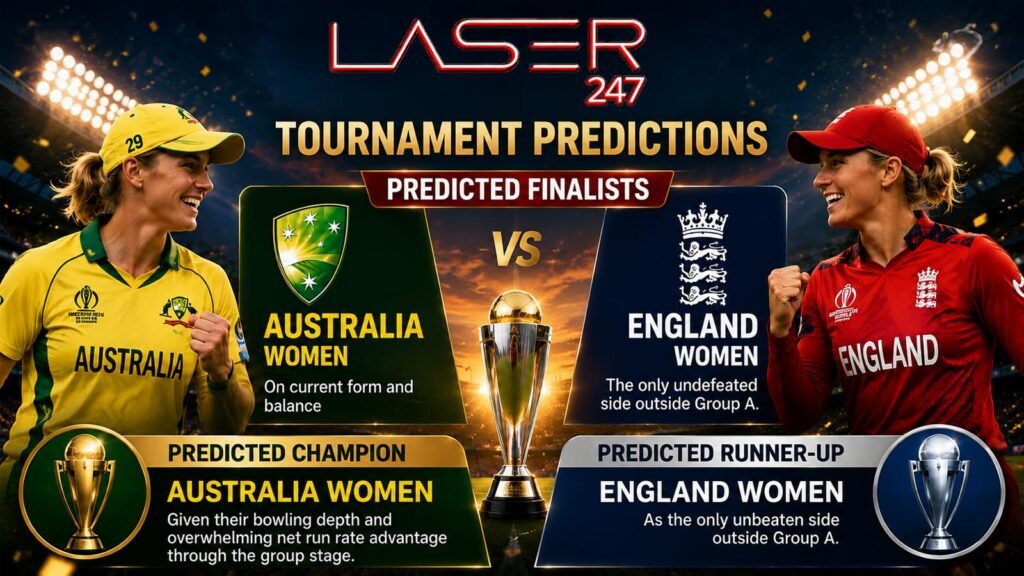
Predicted finalists: Australia and England, on current form and balance.
Predicted champion: Australia, given their bowling depth and overwhelming net run rate advantage through the group stage.
Predicted runner-up: England, as the only unbeaten side outside Group A.
Golden Bat watch: Darcey Carter currently leads with 208 runs but Scotland’s campaign is over so her tally is frozen. England’s Danni Wyatt-Hodge (193 runs) has at least two more innings to chase her down — if England reach the final, that makes Wyatt-Hodge the smarter pick from here.
Golden Ball watch: Shree Charani leads with 12 wickets and, unlike most of her closest challengers, has more matches left to play if India advance — the strongest position of anyone on the wicket-takers’ list.
Player of the Tournament watch: Ellyse Perry and Marizanne Kapp are the standout all-round contenders if their teams go deep into the knockouts.
Emerging Player watch: Shree Charani is the clear front-runner given her wicket-taking and her side’s run.
Highest team total watch: England’s 219 for 1 at Edgbaston is the mark to beat and a flat Oval or Lord’s pitch in the knockouts could threaten it.
Most exciting matches still to come: Both semi-finals at The Oval and the final at Lord’s, with the added spice of today’s Australia vs India result shaping exactly who plays whom.
Biggest Upset of ICC Women’s T20 World Cup 2026
The upset of this tournament has already happened, and it’s a big one.
Defending champions New Zealand were eliminated in the group stage. A team that won the trophy for the first time in 2024, with Amelia Kerr fresh into the captaincy and playing some of the best individual cricket of her career, lost too many close matches and ran out of group games. It is a reminder that in T20 cricket, even champions get no guarantees.
Looking ahead, the next most realistic upset would be the West Indies beating Australia in the semi-finals, if the draw works out that way. It would not be unprecedented — the West Indies famously stunned Australia in the 2016 final, ending a run of Australian dominance. Hayley Matthews’s side still has enough power-hitting depth to do it again on the right day.
Laser247’s Tactical Analysis
Powerplay strategy has separated the contenders from the rest. England’s 219 for 1 against Sri Lanka came from an aggressive, low-risk approach in the first six overs that set up the entire innings.
Death overs discipline has decided tight net-run-rate battles all tournament. South Africa’s 88-run win over the Netherlands was built on a controlled finish — they lifted their net run rate by more than a full run per over in a single match.
Spin versus pace has been a genuine theme: India, Bangladesh and Pakistan have leaned heavily on spin, while England’s home conditions have rewarded a more even mix.
The clearest winning formula so far has been control with the ball in the middle overs, paired with a top order willing to take the powerplay on rather than play it safe.
Laser247’s Venue Analysis
Lord’s: hosting the final, is traditionally a fair contest between bat and ball, with enough in the pitch early on to interest the bowlers before it settles down.
The Oval: hosting both semi-finals, tends to play true and reward power-hitters thanks to its larger square boundaries.
Edgbaston: has already shown itself to be the most batter-friendly venue of the tournament, producing the highest total of the group stage.
Old Trafford & Headingley have offered more for the seamers, especially under grey Manchester and Leeds skies.
The Bristol County Ground & The Rose Bowl in Southampton have generally split the difference, rewarding sides that bat and bowl well in all phases rather than relying on one skill alone.
Laser247 Fantasy Cricket Insights
For captaincy picks, proven all-format performers like Ellyse Perry, Harmanpreet Kaur and Laura Wolvaardt carry the lowest risk because they contribute in more than one way. For vice-captain, in-form impact players like Marizanne Kapp and Shree Charani offer strong upside. A differential worth considering while she was still playing was Netherlands captain Babette de Leede, who kept scoring even as her team lost. Value picks tend to come from associate-nation players who are cheap on price but have shown they can compete, as Darcey Carter proved for Scotland. As always with fantasy sport, past form is a guide, not a guarantee — conditions, match-ups and a single good or bad day can change everything.
Expert Analysis Corner by Laser247
Step back from the individual storylines and a few patterns stand out. Net run rate, not just wins and losses, has shaped this tournament more than any single edition before it. Three different group-stage finishes (Group B’s second and third place, Group A’s entire race for second) have come down to fractions of a run per over.
Momentum has mattered less than discipline: New Zealand arrived with arguably the best individual form of any captain in the tournament and still went out, while England’s unbeaten run has been built on consistency rather than any one standout performance.
For neutral fans, that is the most interesting trend to watch heading into the knockouts. The side that manages pressure best, over the side that simply has the most star power, has had the better of this tournament so far.
This guide reflects publicly available tournament information as of June 28, 2026, sourced from ICC, ESPNcricinfo and official team announcements. Group A’s final semi-final places were still being determined at the time of writing. Check official ICC channels for confirmed results.
FAQs
Q1: Who will win the ICC Women’s T20 World Cup 2026? No one knows for certain but Australia are the strongest pick based on form. They are unbeaten through the group stage with the best net run rate of any team, and are the most successful side in the tournament’s history, with six previous titles.
Q2: Which team is the favourite? Australia, currently unbeaten and with a commanding net run rate, are the bookmakers’ and analysts’ favourite. England, also unbeaten through Group B, are a close second.
Q3: Who is the strongest batter in the tournament? Several stand out, including India’s Smriti Mandhana, South Africa’s Laura Wolvaardt and the West Indies’ Hayley Matthews. Among the in-form pure run-scorers, England’s Danni Wyatt-Hodge and Scotland’s Darcey Carter have led the charts.
Q4: Who has the best bowling attack? Australia’s attack is the most balanced top to bottom, while India’s spin trio led by Shree Charani has been the most individually destructive unit of the tournament so far.
Q5: Which underdog could surprise everyone? The West Indies, given their pedigree as 2016 champions, are the team best placed to cause an upset against a higher-ranked side in the knockouts, particularly against Australia.
Q6: Which venue helps spinners most? No single venue in this tournament has been a pure spinner’s paradise. But slower, drier surfaces later in the group stage have offered more turn than the fresh, batter-friendly Edgbaston pitch used early on.
Q7: Which captain has the best tactical record? Among active captains at this World Cup, Australia’s system (now led by Sophie Molineux) and England’s Nat Sciver-Brunt have the strongest recent records, though Hayley Matthews’s 2016 title win gives her real knockout pedigree too.
Q8: Which player could become Player of the Tournament? Ellyse Perry and Marizanne Kapp are the leading contenders, if their teams reach the final, given their consistent all-round contributions across the group stage.
Q9: What is the tournament format? Twelve teams are split into two groups of six. Each team plays the other five teams in its group once. The top two from each group reach the semi-finals and the two semi-final winners meet in the final.
Q10: How many teams are playing, and how many have won it before? Twelve teams are competing in 2026, the most ever. Only four nations have ever won the title — Australia (six times), England, the West Indies and New Zealand, who won their first title in 2024.
Voice Search Questions and Answers
When is the Women’s T20 World Cup 2026 final? The final is on Sunday, July 5, 2026, at Lord’s Cricket Ground in London.
Where is the Women’s T20 World Cup 2026 being held? In England and Wales across seven venues, from June 12 to July 5, 2026.
Who is the defending champion of the Women’s T20 World Cup? New Zealand, who won their first title in 2024, beating South Africa in the final.
How many teams are in the 2026 Women’s T20 World Cup? Twelve teams, the largest field in the tournament’s history.
Who is India’s captain at the Women’s T20 World Cup 2026? Harmanpreet Kaur, with Smriti Mandhana as vice-captain.
Who is Australia’s captain at the Women’s T20 World Cup 2026? Sophie Molineux, leading her first major tournament in charge.
Has New Zealand been eliminated from the Women’s T20 World Cup 2026? Yes. The defending champions lost their final group match and were eliminated in the group stage.
Who has won the most Women’s T20 World Cup titles? Australia, with six titles: 2010, 2012, 2014, 2018, 2020 and 2023.
Where are the Women’s T20 World Cup 2026 semi-finals being played? Both semi-finals are at The Oval in London, on June 30 and July 2.
Has India ever won the Women’s T20 World Cup? No. India’s best finish is runner-up, in 2020, when they lost to Australia at the MCG.
Who is the leading wicket-taker at the Women’s T20 World Cup 2026? India’s Shree Charani, with 12 wickets, the most of any bowler so far.
Who is the leading run-scorer at the Women’s T20 World Cup 2026? Scotland’s Darcey Carter led at the end of the group stage with 208 runs.
What happens if a match is tied at the Women’s T20 World Cup 2026? A Super Over decides it. If that is also tied, additional Super Overs are played until there’s a winner.
Is England hosting the Women’s T20 World Cup for the first time since 2009? Yes. England hosted and won the very first edition in 2009 and is hosting again in 2026.
How much prize money is on offer at the Women’s T20 World Cup 2026? A total of $8.76 million. The champions receive $2.34 million, and the runners-up receive $1.17 million.